

You can replace the carbon brushes in a radiator fan motor only if it is a serviceable brushed motor and the manufacturer provides a brush kit and repair procedure for that exact model. A brushless motor has no carbon brushes. For a sealed brushed motor that the vehicle manufacturer services as a unit, replace the specified motor or fan assembly. This Yongshang Cooling guide explains how to make that decision.
Identify the motor before ordering brushes
Start with the motor label, the OE number on the fan assembly and the vehicle’s service information. Look for a separately listed brush kit and a procedure for that part number. An external cover or a two-pin connector alone does not establish that the brushes are serviceable. ebm-papst BLDC

Confirm the fault before opening the motor
| What you find | What to check next |
|---|---|
| The fan does not run when commanded | Follow the service procedure to verify the command, power and ground, including circuit checks under the specified load. |
| The fan starts intermittently | Check the connector, harness and speed-control circuit. Intermittent operation can have several causes. |
| The fan runs slowly or is noisy | Check for blade or shroud interference and bearing drag with the circuit isolated as specified by the manufacturer. |
| A connector or housing is heat-damaged | Repair the cause and replace the affected parts as specified. A brush kit alone cannot correct heat damage. |
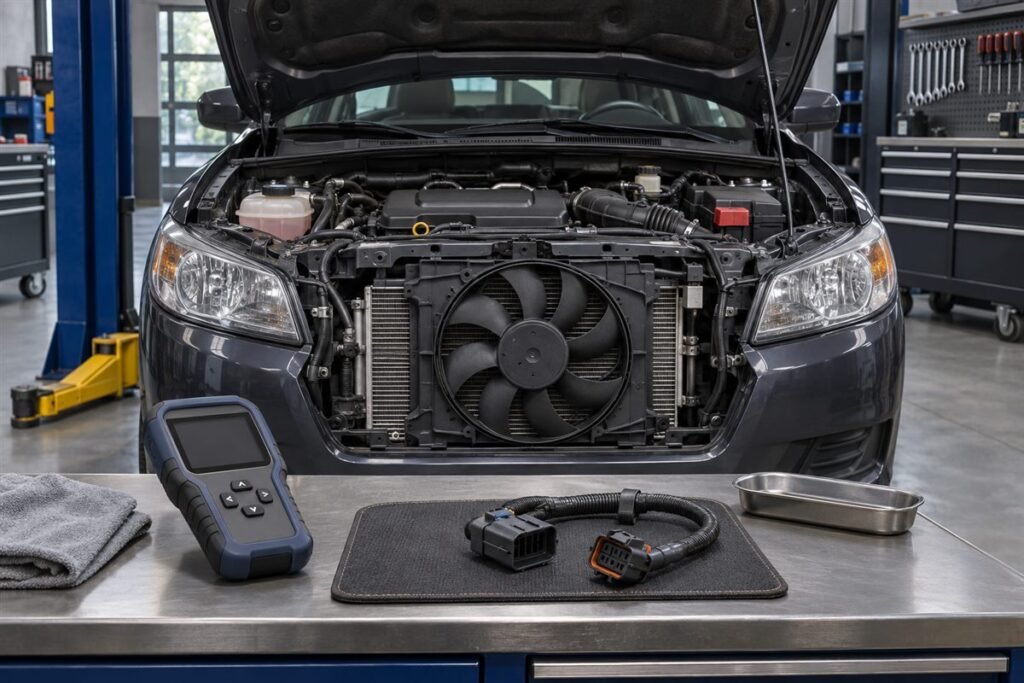
Inspect the commutator and brush gear
If the manufacturer authorizes brush service, compare brush wear, holder movement and spring condition with its limits. Examine the commutator for deep grooves, burnt segments or other damage. A uniform dark film can be normal. Check bearings and signs of winding damage before choosing a brush-only repair. Use the specified brush set or holder assembly, including the correct material grade, leads and springs. Matching the block dimensions alone is insufficient. Morgan Advanced Materials · Morgan DC motor maintenance
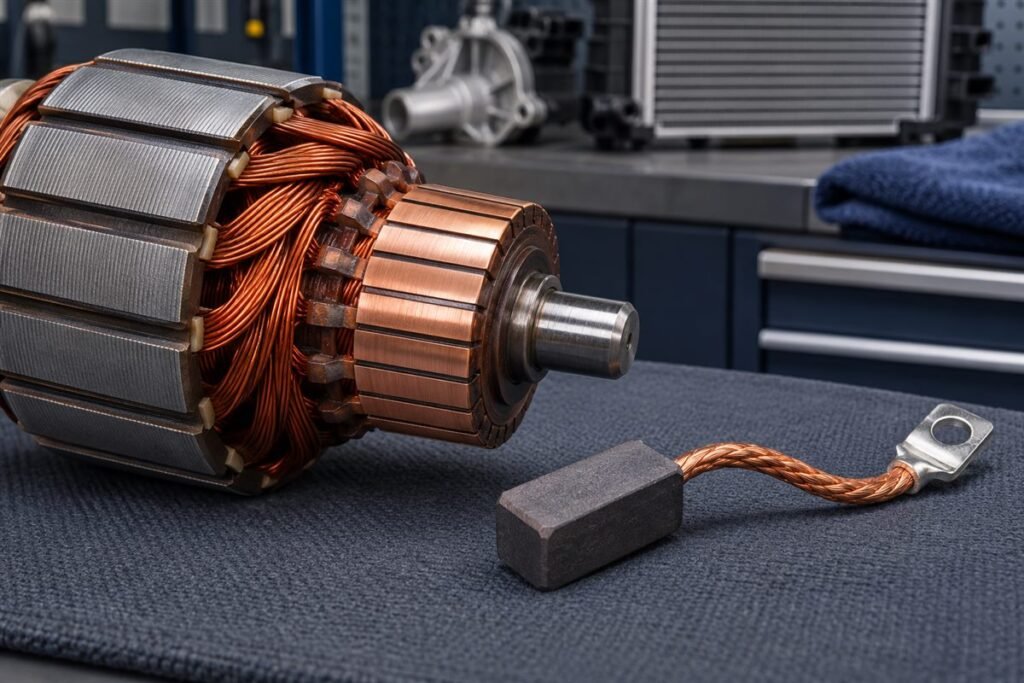
Decide between a brush kit, motor and fan assembly
Choose the brush kit only when the manufacturer lists it and the rest of the motor meets its limits. Order a standalone motor when the catalogue lists one for the original fan assembly. Otherwise follow the specified assembly replacement. Match OE number, mounting points, shaft and blade attachment, rotation, voltage, connector and control type. After the repair, reinstall the shroud and verify the applicable fan stages and cooling response using the manufacturer’s procedure. FCA VB2

AI-generated editorial illustration of generic parts and workshop scenes.
Need to match a radiator fan motor?
Send Yongshang Cooling the OE reference, motor label, vehicle year and engine, connector and mounting photos, and quantity. Say whether you need the motor only or the complete fan assembly.